
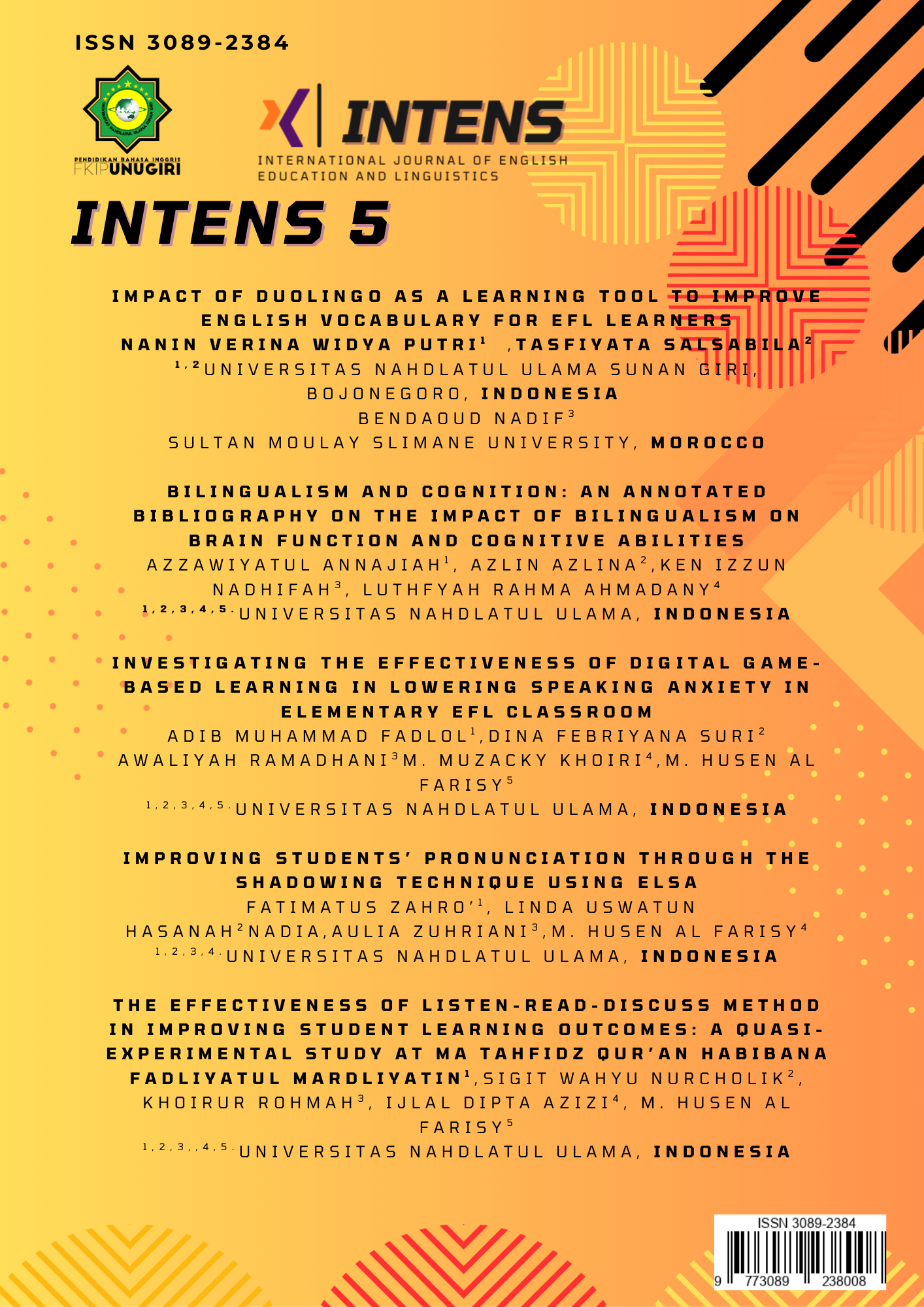
Bilingualism and Cognition: An Annotated Bibliography on the Impact of Bilingualism on Brain Function and Cognitive Abilities
 Abstract View: 104,

DOI:
https://doi.org/10.32665/intens.v3i1.6143Keywords:
bilingualism, cognition, executive control, brain function, annotated bibliographyAbstract
Bilingualism has received increasing attention in cognitive science and applied linguistics due to its potential influence on brain function and cognitive abilities across the lifespan. This study aims to examine how bilingualism is conceptualized and discussed in relation to cognition, executive control, and neural adaptation through a structured annotated bibliography. Employing a qualitative descriptive approach, this study reviews and critically evaluates ten selected scholarly sources, including journal articles, book chapters, and review studies, using document analysis to identify their objectives, theoretical frameworks, methods, key findings, and scholarly contributions. The results indicate that bilingualism is consistently portrayed as a cognitively demanding experience that engages executive control and attentional systems, leading to adaptive changes in cognitive and neural functioning rather than simple transfer effects. However, the reviewed literature also reveals considerable variability in cognitive outcomes, influenced by factors such as age of acquisition, language proficiency balance, and patterns of language use. In conclusion, this annotated bibliography demonstrates that the cognitive effects of bilingualism are complex, context-dependent, and shaped by individual bilingual experiences. The originality of this study lies in its systematic organization and critical evaluation of influential works on bilingualism and cognition, providing a coherent overview that clarifies ongoing debates and offers implications for future research in cognitive science, linguistics, and educational contexts.
References
Ali, A. M. (2023). The effect of bilingualism on cognitive development in children: Review article. Alustath Journal for Human and Social Sciences, 62(4), Article 20. https://doi.org/10.36473/ujhss.v62i4.2278
Bak, T. H., Nissan, J. J., Allerhand, M. M., & Deary, I. J. (2014). Does bilingualism influence cognitive aging? Annals of Neurology.
Beatty-Martínez, A. L., Navarro-Torres, C. A., Dussias, P. E., Bajo, M. T., Guzzardo Tamargo, R. E., & Kroll, J. F. (2020). Interactional context mediates the consequences of bilingualism for language and cognition. Journal of Experimental Psychology: Learning, Memory, and Cognition, 46(6), 1022–1047. https://doi.org/10.1037/xlm0000770
Bialystok, E. (2015). The impact of bilingualism on cognition. In R. Scott & S. Kosslyn (Eds.), Emerging trends in the social and behavioral sciences. John Wiley & Sons.
Bialystok, E. (2021). Bilingualism: Pathway to cognitive reserve. Trends in Cognitive Sciences, 25(5), 355–364. https://doi.org/10.1016/j.tics.2021.02.003
Bialystok, E. (2024). Bilingualism modifies cognition through adaptation not transfer. Trends in Cognitive Sciences, 28(11), 987–997. https://doi.org/10.1016/j.tics.2024.07.012
Crosby, R., & Prescod, R. (n.d.). Effects of bilingualism on cognitive abilities.
Dal Ben, R., Brouillard, M., Gonzalez-Barrero, A. M., Killam, H., Kremin, L. V., Quirk, E., Sander-Montant, A., Schott, E., Tsui, R. K.-Y., & Byers-Heinlein, K. (2022). Effects of bilingualism on cognition. Open Mind: Discoveries in Cognitive Science, 6, 90–118. https://doi.org/10.1162/opmi_a_00057
De Groot, A. M. B. (2020). Bilingualism and cognition. In C. A. Chapelle (Ed.), The concise encyclopedia of applied linguistics. John Wiley & Sons.
Garbin, G., Sanjuan, A., Forn, C., Bustamante, J. C., Rodriguez-Pujadas, A., Belloch, V., Hernandez, M., Costa, A., & Ávila, C. (2010). Bridging language and attention: Brain basis of the impact of bilingualism on cognitive control. NeuroImage, 53, 1272–1278.
Kaushanskaya, M., & Prior, A. (2014). Variability in the effects of bilingualism on cognition: It is not just about cognition, it is also about bilingualism. Bilingualism: Language and Cognition.
Kroll, J. F., & Bialystok, E. (2013). Understanding the consequences of bilingualism for language processing and cognition.
López, B. G., Luque, A., & Piña-Watson, B. (2023). Context, intersectionality, and resilience: Moving toward a more holistic study of bilingualism in cognitive science. Cognitive Science, 47(3), e13258. https://doi.org/10.1111/cogs.13258
Van Dijk, M., Kroesbergen, E. H., Blom, E., & Leseman, P. P. M. (2019). Bilingualism and creativity: Towards a situated cognition approach. Journal of Creative Behavior, 53(2), 178–193. https://doi.org/10.1002/jocb.362
Vega-Mendoza, M., West, H., Sorace, A., & Bak, T. H. (2015). The impact of late, non-balanced bilingualism on cognitive performance. Cognition, 137, 40–46. https://doi.org/10.1016/j.cognition.2014.12.008
Xia, T., An, Y., & Guo, J. (2022). Bilingualism and creativity: Benefits from cognitive inhibition and cognitive flexibility. Frontiers in Psychology, 13, 1016777. https://doi.org/10.3389/fpsyg.2022.1016777
 Abstract View: 104,
pdf Download: 0
Abstract View: 104,
pdf Download: 0