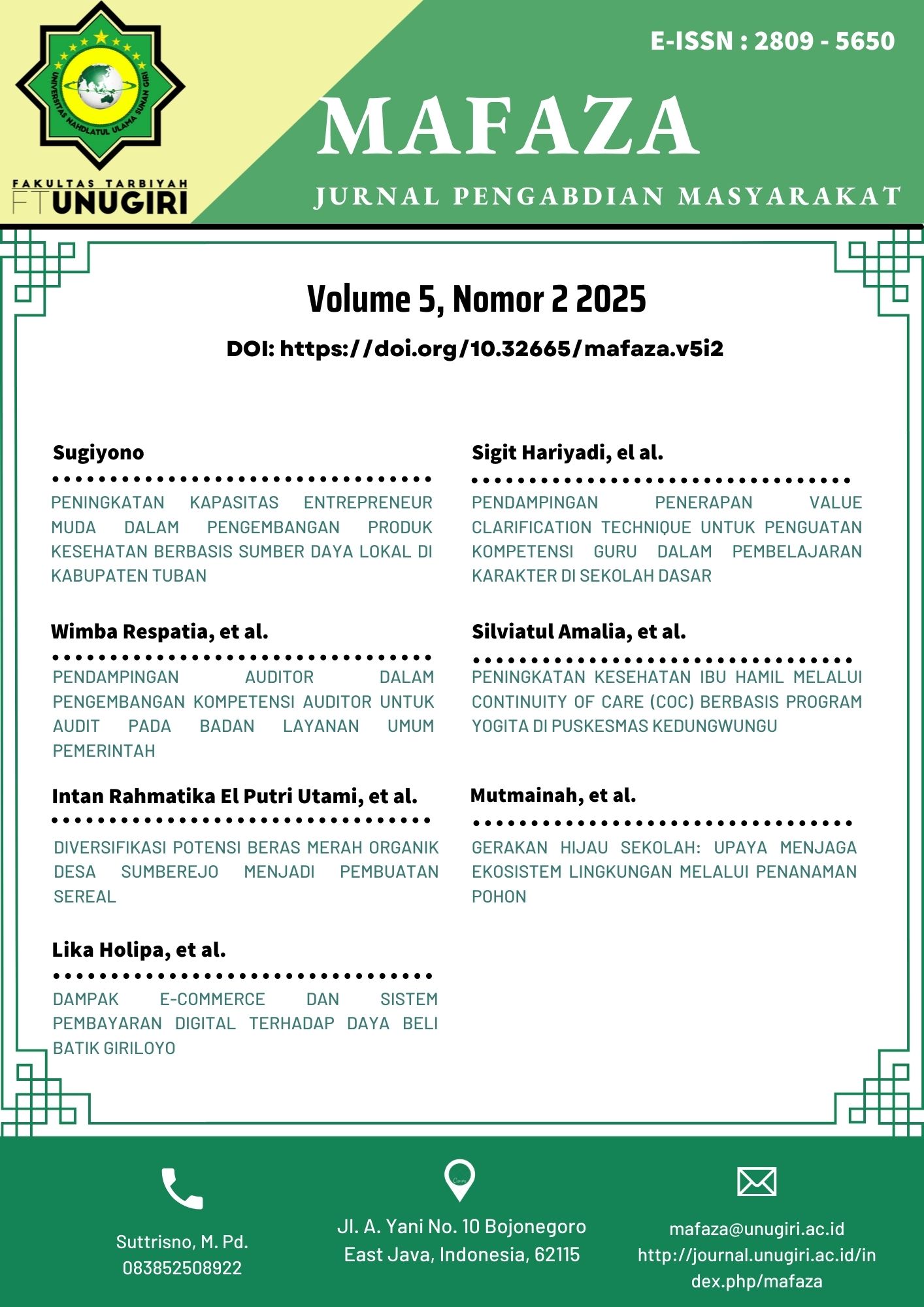
PENDAMPINGAN PENERAPAN VALUE CLARIFICATION TECHNIQUE UNTUK PENGUATAN KOMPETENSI GURU DALAM PEMBELAJARAN KARAKTER DI SEKOLAH DASAR
 Abstract View: 107,

DOI:
https://doi.org/10.32665/mafaza.v5i2.5631Keywords:
Character Education, Value Clarification Technique (VCT), Competece, TeacherAbstract
Character education in elementary schools remains a challenge, particularly with regard to students’ low level of social awareness, the emergence of bullying behavior, and the suboptimal internalization of values such as empathy and tolerance. These conditions indicate limitations in pedagogical approaches to character education that have not yet systematically engaged students in value reflection processes. This community service program aimed to enhance the pedagogical competence of elementary school teachers in implementing character education based on the Value Clarification Technique (VCT). The program was conducted in Sambirejo Village, Semarang Regency, involving 16 teachers from two elementary schools as partner institutions. The service employed a participatory training and mentoring approach, including needs analysis, VCT workshops, mentoring during classroom implementation, and evaluation. Data were collected through pre- and post-tests of teachers’ understanding, observations of instructional practices, and reflective mentoring notes, and were analyzed using descriptive statistics and qualitative analysis. The results indicate an improvement in teachers’ understanding of VCT concepts and implementation steps, changes in instructional practices toward more dialogical and reflective learning, and improvements in classroom dynamics characterized by increased empathy, mutual respect, and students’ prosocial behavior. These findings demonstrate that VCT-based mentoring is effective in strengthening character education in elementary schools and contributes to the development of a child-friendly and character-oriented school culture.
References
Aini, F. Q., Hasibuan, R. Y. A., & Gusmaneli, G. (2024). Pendidikan Karakter Sebagai Landasan Pembentukan Generasi Muda. Dewantara: Jurnal Pendidikan Sosial Humaniora, 3(4), 54–69. https://doi.org/https://doi.org/10.30640/dewantara.v3i4.3321
Berkowitz, M., & Bier, M. (2005). What Works In Character Education:A research-driven guide for educators. Character Education Partnership.
Cahyani, D., Musyrif, M. T., Manasikana, A., Nurfaradila, E., K, I. N. P., H, R. Q., Dewi, A. A., Khumairotin, U., Fatah, D. K., & Ilmi, D. (2025). Sosialisasi Peningkatan Karakter Moral dan Etika Anak dengan Psikoedukasi Berbasis Short Movie. Mafaza: Jurnal Pengabdian Kepada Masyarakat, 5(1), 42–55. https://doi.org/https://doi.org/10.32665/mafaza.v5i1.4135
Davis, M. H. (1983). Measuring Individual Differences in Empathy. Journal of Personality and Social Psychology, 132(2), 397–410. https://doi.org/https://doi.org/10.1037/0022-3514.44.1.113
Herwani, S. (2023). Implementasi Profil Pelajar Pancasila dalam Pembentukan Pendidikan Karakter bagi Siswa Sekolah Dasar. Jurnal Pendidikan Surya Edukasi (JPSE), 9(2), 112–126. https://doi.org/https://doi.org/10.37729/jpse.v9i2.3784
Hidayati, B. N. (2023). The Value Clarification Technique Learning Model Improves the Character of Elementary School Students. International Journal of Elementary Education, 7(2). https://doi.org/https://doi.org/10.23887/ijee.v7i2.58502
KPAI. (2019). KPAI: 67 Persen Kekerasan Bidang Pendidikan Terjadi di Jenjang SD. KPAI, 1–6. https://www.kpai.go.id/publikasi/kpai-67-persen-kekerasan-bidang-pendidikan-terjadi-di-jenjang-sd
KPAI. (2024). HARDIKNAS : Bergerak Serentak Wujudkan Perlindungan Anak Pada Satuan Pendidikan. KPAI, 1–4. https://www.kpai.go.id/publikasi/hardiknasbergerak-serentak-wujudkan-perlindungan-anak-pada-satuan-pendidikan
Lickona, T. (1991). Educating for Character. How Our Schools Can Teach Respect and Responsibility. Bantam Books.
Lin, Z., & Jiang, Y. (2023). Character strengths, meaning in life, personal goal, and career adaptability among impoverished college students: A chain-mediating model. Heliyon, 9(2), e13232. https://doi.org/10.1016/j.heliyon.2023.e13232
Misyanti, M., Yuliana, Y., Ningsih, A., Kurnia, A., Sya’ban, A. C. N., & Mayu, I. (2024). Sosialisasi Kewarganegaraan dalam Mengantisipasi Bullying di Mts Hubbul Bilad. Octo: Community Service Journal, 1(1), 35–45.
Muhorakeye, O., & Biracyaza, E. (2021). Exploring Barriers to Mental Health Services Utilization at Kabutare District Hospital of Rwanda : Perspectives From Patients. Front. Psychol, 12(March). https://doi.org/10.3389/fpsyg.2021.638377
Nucci, L., Krettenauer, T., & Thompson, W. C. (2014). Handbook of Moral and Character Education (2nd ed.). Routledge.
Nurhabibah, S., Sari, H. P., & Fatimah, S. (2025). Pendidikan Karakter di Era Digital : Tantangan dan Strategi dalam Membentuk Generasi Berakhlak Mulia. Jurnal Manajemen Dan Pendidikan Agama Islam, 3(3), 194–206.
Peterson, C., & Seligman, M. E. P. (2004). Character strengths and virtues: A handbook and classification (Vol. 1). Oxford University Press.
Raths, L. E., Harmin, M., & Simon, S. B. (1978). Values and teaching : working with values in the classroom. Charles E Merrill.
Simon, S. B., Howe, L. W., & Kirschenbaum, H. (1995). Value Clarification: A Practical, Action-Directed Workbook. In Suparyanto dan Rosad (2015 (Vol. 5, Issue 3). The Warner Books.
Simon, S. B., L.W., H., & Kirschenbaum, H. (1972). Values Clarification . A Handbook of Practical Strategies for Teachers and Students. Hart Publishing.
Suttrisno, S., Elmuna, F. N., & Fithriyah, D. N. (2024). Pengaruh Model Pembelajaran VCT (Value Clarification Technique) Berbasis Kearifan Lokal Bojonegoro terhadap Literasi Membaca Siswa Madrasah Ibtidaiyah. JIIP-Jurnal Ilmiah Ilmu Pendidikan, 7(1), 629-634.
Tondok, M. S., Agustin, I. C., Eka, N., Maris, S., Yasmin, R., Leonardo, L., & Kinanti, A. D. P. (2023). Psikoedukasi untuk Peningkatan Pengetahuan dan Empati Guna Mengatasi Perundungan di SMP ‘X’ Surabaya. INTEGRITAS: Jurnal Pengabdian, 7(1), 176–186. https://doi.org/https://doi.org/10.36841/integritas.v7i1.2292
Xie, J., Liu, M., Zhong, Z., Zhang, Q., Zhou, J., Wang, L., Ma, K., Ding, S., Zhang, X., & Sun, Q. (2020). Relationships Among Character Strengths, Self-efficacy, Social Support, Depression, and Psychological Well-being of Hospital Nurses. Asian Nursing Research, 14(3), 150–157. https://doi.org/https://doi.org/10.1016/j.anr.2020.06.002
Yusrizal, Y., & Hariati, E. (2022). The Influence of The Value Clarification Technique (VCT) Learning Model and The National Insight on The Character of Elementary School Students. Jupiis: Jurnal Pendidikan Ilmu-Ilmu Sosial, 14(2), 133. https://doi.org/https://doi.org/10.24114/jupiis.v14i2.38659
Downloads
Published
Issue
Section
License
Copyright (c) 2025 Sigit Hariyadi, Indrajati Kunwijaya, Achmad Miftachul 'Ilmi, Petra Kristi Mulyani, Kusnarto Kurniawan, Maria Theresia Sri Hartati, Nailah Rizqia Azhar, Dewi Ayu Setiyawati, M. Khautalfata Suhur, Mustofa Danu Seto

This work is licensed under a Creative Commons Attribution 4.0 International License.
Abstract View: 107,
PDF Download: 121